Fulfillment Nutra

Connect funnels and checkouts to fulfillment without losing attribution.

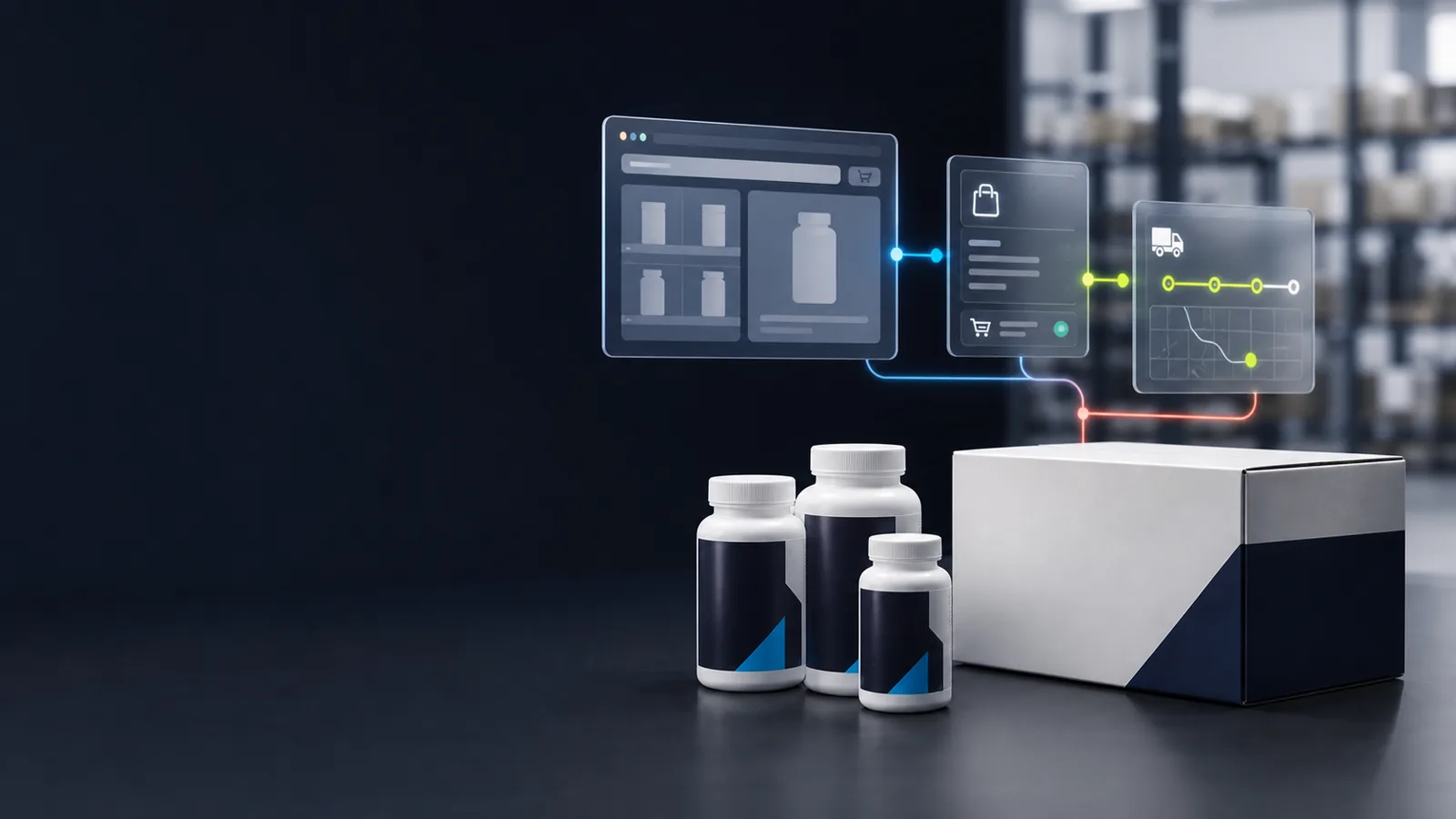
Connect funnels, external checkout, single-sale or recurring flows to traceable supplement fulfillment with payment, SKU and tracking validation.

Connect funnels and checkouts to fulfillment without losing attribution.

Direct answer

Connect funnels and checkouts to fulfillment without losing attribution.

A funnel or external checkout can feed Fulfillment Nutra when payment evidence, order ID, attribution identifiers, SKUs, address and refund rules are transmitted reliably. Shopify is not required and marketing attribution can remain in your stack.

Shopify is optional, not required

Fulfillment Nutra should not force a single commerce platform. For funnels, payment, attribution and order states, the starting point is the protocol that actually exists and the client’s system of record. A custom storefront, proprietary backend, WooCommerce store, funnel, marketplace or external checkout can be assessed when the flow can transmit the required facts securely.

Every order needs a stable identity

Each sale should preserve a stable external identifier and explicit SKU mapping. If a webhook or API request is replayed, idempotency should return the same logical result rather than create another order. This becomes essential for funnels, payment, attribution and order states, especially when several tools or teams touch the lifecycle.

Payment and fulfillment remain separate facts

A successful checkout screen is not enough. The flow needs to know which event or authority genuinely confirms payment and how authorized, pending, failed, cancelled and refunded states behave. Fulfillment is released only by the state defined in the operating contract for funnels, payment, attribution and order states.

Status feedback matters as much as order intake

A professional integration does more than import an order. Tracking, shipment, invalid address, unavailable SKU, cancellation or other exceptions should reconcile back to the source system when the protocol supports it. This reduces manual support and prevents customers from seeing contradictory states.

Compliance is independent from the connector

A working API does not authorize a product for sale in a market. Product, label, claims, responsible operator, documents and destination keep their own validation requirements. funnels, payment, attribution and order states therefore needs technology and governance to work together without turning technical feasibility into a regulatory promise.

Measure before scaling

After activation, track error rate, retries, latency, blocked orders, missing tracking, cancellations, refunds and time to resolution. For funnels, payment, attribution and order states, these signals describe system quality far better than a simple “connected” badge.

FAQ

Frequently asked questions

Can I keep my existing checkout?

Yes when its protocol can reliably provide the information and states required for fulfillment. The checkout can remain inside your stack.

Do I need to migrate to Shopify?

No. Shopify is one possible channel, not a dependency. The right approach depends on your architecture, access and the flow you need to preserve.

Can we start with one channel or one brand?

Yes. A limited pilot is often the safest way to validate mapping, payment, exceptions, tracking and responsibilities before expansion.

Does an on-request integration mean a native partnership?

No. It means a connection can be assessed based on available APIs, permissions and conditions. No third-party partnership is implied.

How are duplicates prevented?

With stable external identifiers, idempotency keys and retry rules that make repeated requests safe.

Turn the idea into a verifiable project.

Create your workspace to review the catalog and confirm the products, markets and capabilities that are actually available.

Create an account